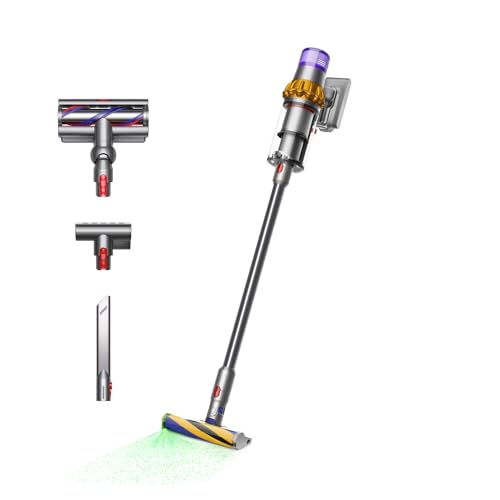
The Dyson V15 Detect is the model that made Dyson’s cordless line gadget-rich. It launched in the United States on March 24, 2021, and it is still sold in 2026 alongside the newer Dyson V16 Piston Animal. Its two signature features are a green laser on one of its floor heads and a sensor that counts and sizes the dust it pulls in. This profile pulls together what Dyson’s user manual, Vacuum Wars and TechRadar published about it, so you can decide whether those features are worth carrying around on a heavy stick vacuum.
We did not handle the machine ourselves. We compared published specs and third-party findings, and where those sources disagree, we say so instead of picking a number. It is the top pick in our best cordless vacuums of 2026 ranking.
The Short Version
The V15 Detect is the best all-around choice in our lineup for homes with a mix of hardwood, tile and carpet, especially when there is a shedding pet. Auto mode handles most of the decisions, the Hair Screw tool deals with fur on sofas and car seats, and the battery is removable, so you can add a spare. The trade-offs are weight, a bin that is only average in size, a trigger you hold down, and a premium price tier. If your home is small and mostly hard floor, the lighter Dyson V12 Detect Slim gives you the laser and the sensor in a lighter body.
Key Specs
Dyson’s own pages returned errors when we attempted to open them, so the numbers below come from Vacuum Wars and TechRadar. The Dyson user manual is cited only to explain how the features work.
- Runtime: Up to 60 minutes in Eco mode, according to Vacuum Wars and TechRadar. TechRadar reported about 40 minutes in Auto and about 18 minutes in Boost.
- Weight: 6.8 lb in total, per Vacuum Wars’ spec table (TechRadar lists 6.83 lb, or 2.96 kg). Vacuum Wars gives the handle weight as about 4.6 lb.
- Dust bin: About 0.8 qt (0.76 L) per Vacuum Wars and 0.77 L (about 26 oz) per TechRadar. Vacuum Wars’ summary box shows 880 ml (about 30 oz), so its own page is inconsistent. Treat it as roughly 25 to 26 oz.
- Suction: Vacuum Wars lists 240 AW. TechRadar’s spec table also says 240 AW, but its design section says 230 AW. We would not base a decision on a 10 AW difference.
- Filtration: A sealed system with a HEPA filter, according to Vacuum Wars. That is a filtration spec, not a cleaning-performance promise.
- Floor heads: The Digital Motorbar head, which TechRadar describes as designed for hard floor or carpet, and the Fluffy Optic head (earlier called Laser Slim Fluffy), which is for hard floors and carries the laser.
- Tools: Vacuum Wars lists a Hair Screw tool, a crevice tool, a combination tool, a mini soft dusting brush, a stubborn dirt brush and a wand clip. Both outlets say the exact set varies by retailer and bundle.
- Battery: Click-in and removable. One is included; spares are sold separately.
- Charging: A wall-mounted dock and charger. TechRadar reported a full recharge in 4 to 5 hours.
- Warranty: 2 years, per Vacuum Wars.
How the Detect Features Work
The manual describes a piezo sensor that continuously sizes and counts dust particles at the inlet. The results show on a small LCD as a particle graph, along with the power mode and the remaining run time. TechRadar adds that the sensor picks up vibrations from particles as small as 10 microns and sorts what it hears into four size categories. In Auto mode the machine raises or lowers suction depending on what it detects and what kind of floor it is on.
The laser is the other half. On the Fluffy Optic head, a class 1 green laser lights the floor at a low angle so that fine dust and hair become visible. TechRadar’s two writers disagreed about it. One was surprised by how much dust the laser revealed along room edges that looked clean. The other found that dust settled inside the head and dimmed the beam, so that writer mostly left the laser off. Both agreed the head swivels less freely than the Digital Motorbar.
It helps to know the limits, too. Vacuum Wars points out that the laser is only on the Fluffy head. TechRadar wondered whether the live dust report stays useful once the novelty wears off, though it did find it a handy way to see when a patch of floor was finished.
Vacuum Wars gave the V15 Detect a perfect 100 on its carpet deep-clean measurement and said its sealed suction was class-leading, matching the larger V11 Outsize on sealed suction and airflow at the head. It praised the Hair Screw tool, which handled 1-, 5- and 7-inch hair without tangling, and said the Digital Motorbar head tangled less than the older head but still wrapped some hair. Its main complaint on carpet was push effort: with the front air gate fully closed, the head was very hard to push, especially at maximum power.
TechRadar reported that the machine cleared fine dust, biscuit crumbs and cereal from both carpet and hard floor in a single slow pass, even in Eco mode, and that it handled tangled hair impressively well. It liked Auto mode best, calling it a set-and-forget option. In Boost it measured 81 decibels, which it compared to a truck on a highway.
Living With It
Weight and balance. This is the V15’s weak point. TechRadar said the battery makes the machine feel top-heavy, that its team’s arms tired after about 30 minutes, and that holding the vacuum up in handheld mode for more than a minute or two was difficult. That matters if you plan to clean stairs, ceiling corners or a car with the wand removed. One TechRadar writer did clean a car with it and found the cleaning power strong, but struggled to reach under the front seats and into the console.
The trigger. The V15 uses a trigger that you hold down while you work. Later Dyson models switched to a one-press button. TechRadar called this frustrating, particularly combined with the weight. Short cleanups are fine, but a long session in a big house is more tiring than it should be.
Emptying. There is no auto-empty bin, a limitation Vacuum Wars notes. You remove the wand and attachments, push the red lever on the canister, and the lid opens. TechRadar called this easy. With a bin of about 25 oz (0.75 L), a carpeted home with a long-haired dog will mean frequent trips to the trash.
Battery. Vacuum Wars described the battery numbers as among the best in the business. The practical rule is simple: the one-hour figure is for Eco mode. In Auto, plan on closer to 40 minutes, which TechRadar said is enough for general upkeep of a small two-bedroom house. If you have more floor than that, buy a second battery and swap them.
Pros and Cons
Pros
- Green laser on the Fluffy Optic head shows dust you would otherwise miss on hard floors
- Piezo sensor and LCD show particle counts and adjust suction automatically in Auto mode
- Hair Screw tool handled hair of several lengths without tangling, per Vacuum Wars
- Strong carpet results, including a 100 deep-clean score from Vacuum Wars
- Removable battery, so a spare extends your cleaning time
- Converts to a handheld, and the wand clips on for storage
- 2-year warranty, according to Vacuum Wars
Cons
- About 6.8 lb, top-heavy and tiring in handheld mode
- Trigger must be held down continuously
- Bin of about 25 oz (0.75 L), and no auto-empty option
- Laser works only on the Fluffy head, which TechRadar found less agile than the Motorbar
- Hard to push on carpet with the air gate closed at high power, according to Vacuum Wars
- Attachments vary by retailer, so check what is in the box
- Premium price tier
Who Should Buy It
Pick the V15 Detect if you have hardwood or tile with area rugs and want a machine that adjusts itself, if you live with a shedding dog or cat and will use the Hair Screw tool on furniture, or if you like seeing the dust you pick up. It is also a sensible choice for a house with stairs, as long as you are comfortable with the weight and can store it on the wall dock.
It is the wrong choice for anyone who wants a very light machine, who vacuums for long stretches without a spare battery, or who wants the vacuum to empty itself. Shorter users or people with limited grip strength may prefer the V12. If budget is the priority, our comparison covers less expensive options that skip the sensors.
How It Compares With Other Dysons
The Dyson V16 Piston Animal is the newer flagship, with a compressing bin and a longer quoted runtime. TechRadar’s side-by-side suction measurements found the V16 trailing both the V15 Detect and the Gen5detect, which is a large part of why we rank the V15 higher. The Dyson V12 Detect Slim gives up roughly 18% of the V15’s suction, according to Vacuum Wars, in exchange for a much lighter body. At the bottom of Dyson’s range in this lineup, the Dyson V8 Cyclone drops the screen, the sensor and the laser.
What to Check Before You Buy
- Model name and bundle. The V15 Detect and the V15 Detect Absolute are the same vacuum in different colorways, according to TechRadar, but tool sets differ by retailer. Read the “what’s in the box” section.
- Spare battery. If your home is large, budget for a second click-in battery.
- Wall space. The dock mounts to the wall and the machine hangs from it.
- Your floors. If you mostly have deep-pile carpet, expect to adjust the air gate on the head.
- Safety. Use the charger that comes with it and avoid third-party replacement batteries. The Consumer Product Safety Commission has warned about unbranded replacement battery packs for Dyson vacuums. We found no recall for this model on the CPSC site when we checked.
To see current pricing and bundle options, visit Dyson V15 Detect on Amazon. Buying through our link may earn a commission at no cost to you.
Sources