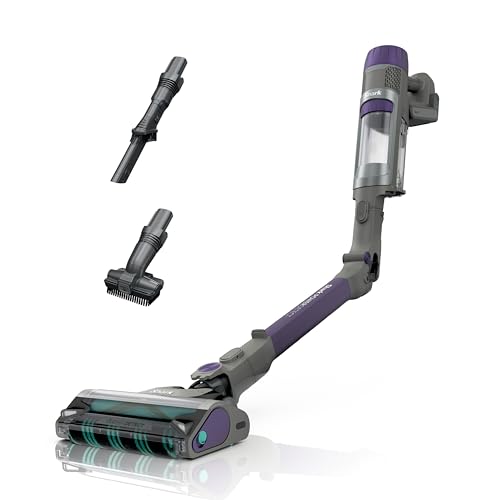
The Shark PowerDetect Cordless, model IP1251, is the dockless sibling in Shark’s PowerDetect family. It uses the same 380-watt motor, the same Detect sensing and the same folding wand as the Clean & Empty version, but it leaves out the auto-empty base. If you have already read about the dock model, think of this as the same vacuum with simpler storage and a lower price tier.
This profile draws on Shark’s product page and on what an independent outlet reported. We did not handle the vacuum ourselves. We compared published specs and third-party findings, and we note which source each figure comes from. To see where it ranks against the rest of the field, start with our best cordless vacuums of 2026 comparison.
Dock or No Dock: The Core Decision
Before you buy, it helps to understand how the two Shark models differ. The Shark PowerDetect Clean & Empty (IP3251) comes with a charging dock that empties the stick’s dust cup into a larger bagless container. Shark says that container holds up to 45 days of dirt and debris. The IP1251 covered here has no dock. It charges from a cord, and you empty the 0.7-quart dust cup yourself.
Vacuum Wars, which covered both, says they are essentially the same vacuum. It reports that the dust bin design is the main difference besides color: one is built to work with the auto-empty base and the other is not. It published a single set of performance results for both, which is why we use its numbers in both profiles. Do not assume you can add a dock to the IP1251 later, because Shark’s page does not describe that option.
So the question is not which vacuum cleans better. It is whether automatic emptying is worth the base’s footprint and higher price tier.
- Pick the dock model if you have shedding pets, a larger home, or you simply dislike handling dust.
- Pick the IP1251 if closet space is tight, you vacuum a few times a week and you do not mind a quick trip to the trash.
Key Specs According to Shark
All figures below are from Shark’s US product page for the IP1251.
- Runtime: Up to 70 minutes in ECO mode, measured at the handheld unit.
- Weight: 8.11 lb.
- Motor: 380 watts, 21.6 volts, 3.75 amps. Shark calls it its most powerful cordless suction and says the claim is based on an ASTM F558 comparison in Boost mode. No airwatt figure is published on the page.
- Dust cup: 0.7 quarts.
- Filtration: Felt and washable foam pre-motor filters and a HEPA post-motor filter. HEPA is a filtration spec and nothing more.
- Nozzle: Shark names a redesigned DuoClean Detect nozzle.
- Wand: MultiFLEX technology lets you bend the wand to clean under furniture.
- In the box: An 8-inch duster crevice tool, a pet multi-tool and a battery and charging cord. A motorized hand tool and a DuoClean soft roller are sold separately.
- Charge time: 6 hours.
- Warranty: A 5-year limited warranty, with 2 years on parts.
- Dimensions: About 16 by 10 by 46 inches.
Shark’s specification table lists one included battery but does not describe it as removable. Vacuum Wars calls the PowerDetect battery detachable, so if swapping batteries matters to you, check the exact listing first.
What Detect Actually Does
PowerDetect is Shark’s name for a set of sensors that change the vacuum’s behavior on the fly. According to Shark, the vacuum detects hidden dirt, edges, carpets and floors and the direction you are cleaning in, and it boosts power automatically when it finds dirt and debris. Vacuum Wars describes four modes: Floor Detect, Dirt Detect, Direction Detect and Edge Detect. Together they raise suction along walls and over dirty patches, change roller speed between carpet and hard floor, and adjust suction on the push stroke versus the pull stroke.
The benefit is mostly battery life. A cordless vacuum burns through its charge quickly at maximum power, so sending boost only where it is needed stretches the usable runtime. You can still choose a mode yourself, but the idea is that you do not have to.
What Vacuum Wars Reported
The comparison table in Vacuum Wars’ write-up of the Bissell PowerClean DualBrush lists the IP1251 as a benchmark, and its Shark page covers both versions. Taken together, its results for the PowerDetect were as follows:
- 100% in the medium-pile carpet deep-clean test, against a 93% average for cordless vacuums.
- The top result in the 14-inch hair-tangle measurement, where the cordless average is lower.
- About 13 minutes of runtime at maximum power with the floor head on, close to the 13.5-minute category average.
- A dust bin capacity of 700 ml (about 24 oz) and noise of 82 dB at max power, slightly above average.
- Unsealed head suction of 0.29 kPa, against a 0.58 kPa average, which Vacuum Wars links to the squeegee design letting more air into the floor head.
- A handle weight of about 4 lb (1,804 grams), above the roughly 3.3 lb (1,512 grams) average in that table.
The takeaway: carpet and hair are its strong suit, noise and handle weight are middling, and crevice pickup was above average but not as high as the motor’s power would suggest. Vacuum Wars also notes that the included tool set is minimal, with no motorized hand tool, and that the display is a basic LED battery indicator rather than a percentage.
Weight and Handling
Shark lists 8.11 lb for the IP1251. Vacuum Wars notes that the handle weight is a bit above average because of the larger battery, but still well below some premium Dyson models. The MultiFLEX wand helps in daily use because you can slip the head under a bed or sofa without lifting the vacuum or moving furniture, and it folds for compact storage.
Because there is no dock, storage is flexible. The stick does not need a base or an outlet in a specific spot, so you can keep it in a closet and charge it wherever a cord reaches. Shark’s page does not mention a wall mount, so check the listing images if wall storage is important.
Runtime in a Real Home
The 70-minute figure is a low-power number. In a house with mixed floors, the Detect system will raise power on carpet and dirty patches, and the battery will run down sooner. Vacuum Wars estimated about 30 to 40 minutes in auto mode on the dock model, depending on the share of carpet, based on a 13-minute max-power result. That is enough for a typical apartment or a single floor of a house. To clean a large home in one go, consider a second battery if the listing supports it, or a model with a longer runtime.
With a 6-hour charge time, a dead battery can cost you most of an afternoon.
Who Should Buy It
This vacuum suits:
- Mixed-floor homes. The head adapts between carpet and hardwood without switching attachments.
- Budget-minded pet owners. Vacuum Wars reports strong hair handling, and a pet multi-tool is in the box.
- Apartment dwellers. With no base, storage is simple.
- Shoppers cross-shopping premium sticks. Vacuum Wars describes the PowerDetect models as costing nearly half as much as a premium Dyson and says their performance in many ways surpasses higher-end models.
It is a weaker choice if:
- You hate emptying a bin. Choose the dock model instead.
- You need a motorized hand tool for stairs or car seats and do not want to buy one separately.
- You want a quiet vacuum. At 82 dB at max power, it is slightly louder than average.
Pros and Cons
Pros
- Same sensor system and motor as the dock model
- Strong carpet and hair results, according to Vacuum Wars
- MultiFLEX wand for under-furniture cleaning
- 5-year limited warranty, per Shark
- No dock to find room for
Cons
- You empty the dust cup yourself
- Short maximum-power runtime
- Slightly loud and above-average handle weight
- Tool kit has no motorized hand tool
- Basic LED battery indicator
Where to Buy
See price on Amazon
Sources